Accept your invite
An administrator invites your email. A single-use link securely begins enrollment.
Secure communication for private teams
Live push-to-talk and an encrypted collaboration workspace for private teams—messages, files, voice notes, video, operations, and infrastructure your organization controls.
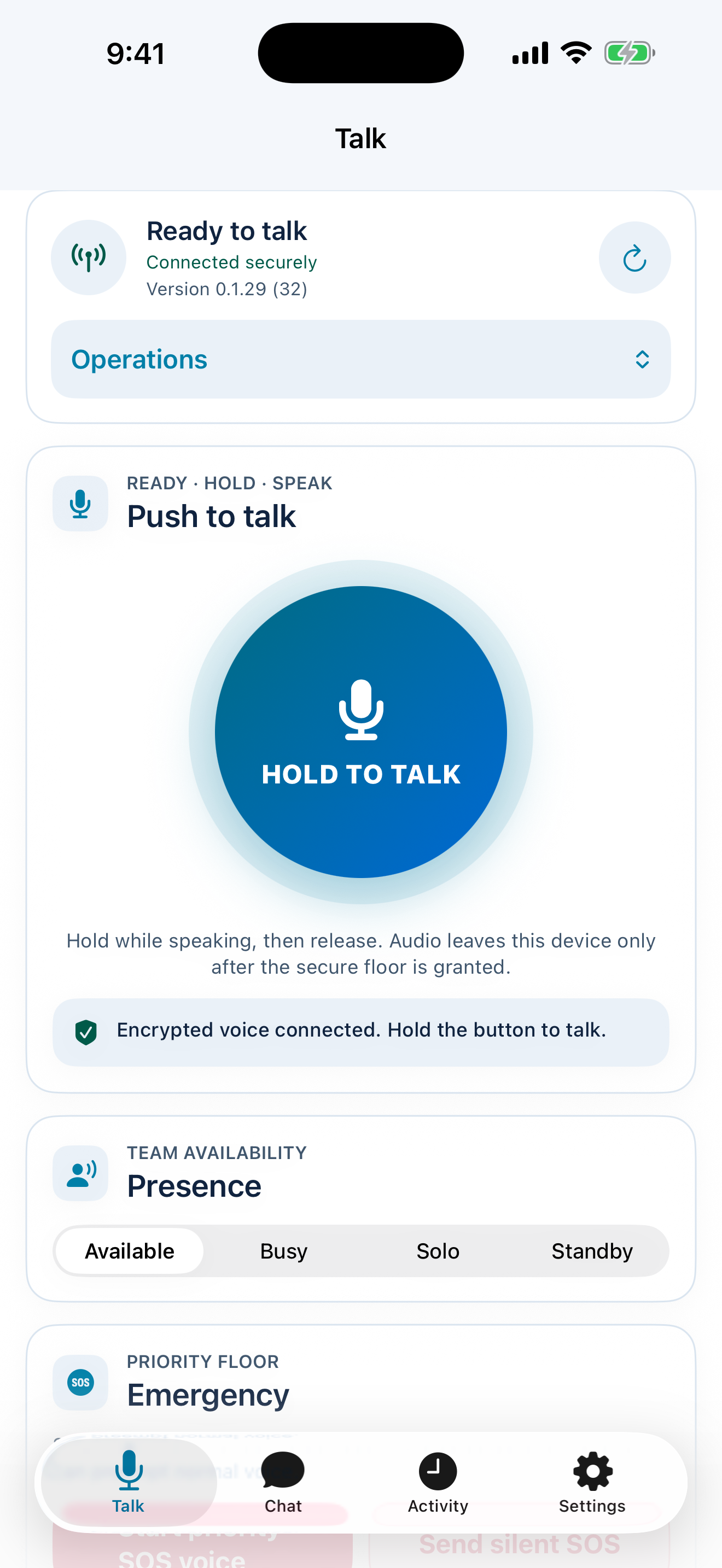
The familiar speed of radio
PTT Talk removes the ceremony of a phone call without giving up authenticated access, reliable delivery, or modern encryption.
An administrator invites your email. A single-use link securely begins enrollment.
Select an assigned private channel and arm Stay connected when you want to receive.
The authenticated floor is granted before microphone audio can leave your phone.
Hold to request the floor, speak, and release. Clear visual states and feedback tones tell you when the channel is yours.
Administrators invite members by email, assign channel roles, and keep every installation single-tenant.
Send text, files, voice notes, and video in the same private channel. Names, captions, media, and keys stay end-to-end encrypted.
Link a second phone without copying device keys. New devices receive future transmissions only—not old history.
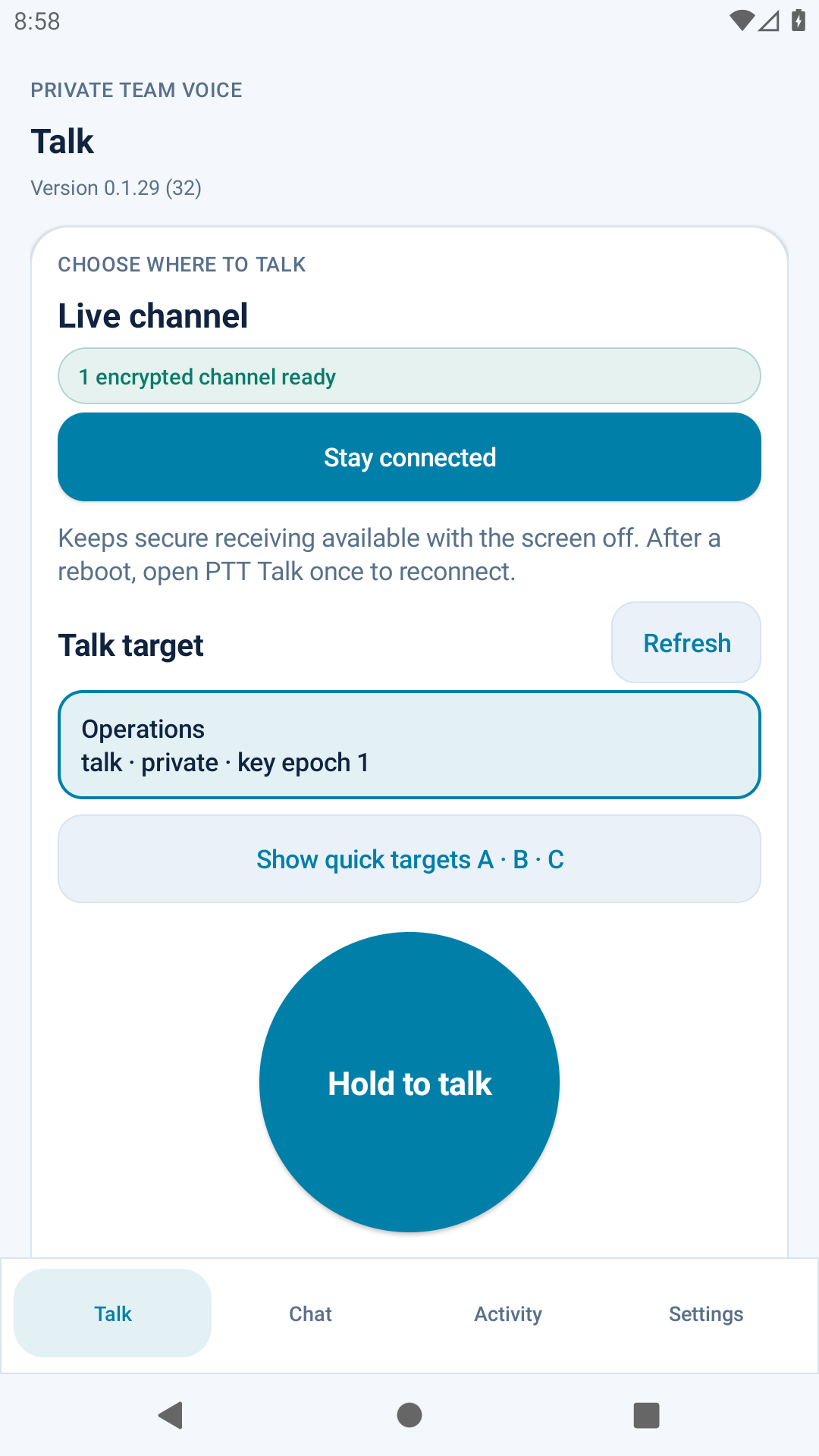
Designed for confidence
Ready, requesting, granted, speaking, reconnecting, and unavailable are distinct states—not mystery spinners. The talk control stays disabled until both channel and encrypted media relay are truly ready.
One private workspace
PTT Talk combines fast voice with the structure teams expect from a modern collaboration app—without turning communication into a public feed or giving the server plaintext content.
Direct messages, private groups, topics, announcements, templates, and user groups keep important work findable.
Send messages, files, photos, video, and WhatsApp-style voice notes with per-device encrypted delivery.
Cross-channel Activity brings assignments, acknowledgements, incidents, and mentions into one focused queue.
Automation identities are scoped to named channels and encrypt for each recipient device—never with a shared admin token.
Security you can inspect
Encryption is part of the transmission path—not a badge added to the interface. Both sides can inspect matching security details.
Voice is encrypted before it leaves your phone. Private identity and session keys stay in protected device storage.
Authenticated floor control, replay protection, source validation, and encrypted UDP or TLS relay transport fail closed.
Relays and history storage receive ciphertext. Operators control membership, retention, backups, and device revocation.
More than a talk button
Move between direct conversations, private groups, and channels without leaving the encrypted workspace.
Give recurring work a dependable structure and target the right people without rebuilding a recipient list every time.
Turn a message into trackable work, capture acknowledgements, and keep time-sensitive updates visible in Activity.
Prioritize an urgent transmission for clearly identified recipients. PTT Talk is not an emergency service.
Invite members, approve a second device, manage roles and retention, review health, and revoke lost phones.
Reconnect across network changes, use encrypted TLS media when UDP is blocked, and export diagnostics without private content.
Deploy it your way
Run a supported single-tenant deployment on K3s with Helm, or use the managed Cloudflare edge stack. You choose the domain, email provider, storage, retention, and operating region.
A complete operator guide covers prerequisites, immutable builds, installation, enrollment, physical audio validation, backup, restore, upgrades, and an AI-agent execution contract.
Next private beta
Version 0.2.0 (build 45) is the synchronized internal-testing candidate. Internal distribution begins after its exact-commit automated software and public-media gates pass.
0.2.0 Build 45
Internal candidate for hardware, lifecycle, and encrypted-call testing.
Private internal testing0.2.0 Build 45
Internal candidate for hardware, lifecycle, and encrypted-call testing.
Open the tester pageProtocol 1.1
Cross-platform wire, service, security, store-readiness, and encrypted collaboration checks are enforced on every candidate revision.
Review the security modelGood to know
No. PTT Talk is invite-only. An instance administrator invites members by email and assigns channel access.
Voice is end-to-end encrypted before relay or storage. The server routes ciphertext and does not receive the private keys needed to decrypt it. Network operators can still observe metadata such as addresses, timing, and traffic volume.
Eligible missed transmissions can be delivered as encrypted history. The operator chooses server retention, and local history is limited to 30 days and 1 GB per device.
Yes. An account can link up to two independently keyed devices. A newly linked device receives future transmissions and is never given earlier history.
Not yet. The synchronized iOS and Android build is available to invited internal testers. Production promotion remains gated on physical acoustic and lifecycle testing, an Android screen-off soak, recovery drills, and an independent security review.
No. Normal and silent SOS can prioritize urgent team communications, but PTT Talk is not an emergency service and should not be relied on to contact emergency responders.
Built in the open
PTT Talk is public under AGPLv3. Inspect the implementation, bring a reproducible problem, or help make encrypted voice easier to deploy and use.
Review the mobile clients, Rust media engine, protocol contract, server, deployment charts, and release evidence.
Open GitHubUse Discussions for architecture and deployment questions, or a structured Issue when you can describe a bug or proposal.
View DiscussionsRead the contribution and security policies before sending code. Vulnerabilities belong in GitHub's private reporting flow.
Contribution guide
PTT Talk
Open source and self-hostable, with synchronized version 0.2.0 (45) available for controlled internal iOS and Android testing.
Explore PTT Talk on GitHubLegal
Effective August 31, 2026
PTT Talk is a private, end-to-end encrypted push-to-talk and channel messaging service for teams. It does not use advertising, analytics, cross-app tracking, or profiling, and it does not sell personal data.
PTT Talk is self-hosted. The organization that operates the PTT Talk instance you join (the Instance Operator) controls the service records on that instance and chooses its infrastructure providers and retention settings. This policy describes the data handled by the PTT Talk software. Your Instance Operator may provide additional terms or privacy information.
Account and team data includes your email address, invitation and recovery status, administrator status, channel memberships and roles, device display names, and random service identifiers.
Security data includes public identity keys and prekeys, hashed access and invitation tokens, device status, key and membership epochs, safety-number material, and security audit events. Private encryption keys remain in the operating system's protected storage on the device.
Push and delivery data includes Apple or Google push tokens, encrypted mailbox and chat envelopes, delivery status, and timestamps. Push messages contain only a privacy-minimized wake signal; they do not contain voice audio, email addresses, channel names, message text, filenames, or captions.
The app uses the microphone only while you actively transmit or record a voice note. Live voice, text, files, voice notes, and video are encrypted on the sending device. Relays and object storage receive ciphertext, not plaintext content or decryption keys.
Operational data includes IP addresses and network source tuples used to route traffic and reject forged packets; floor, presence, relay, authentication, error, and rate-limit events; timestamps; service health; and aggregate operational counts. PTT Talk's supported metrics and support exports omit email addresses, raw account, device, mailbox, and channel identifiers, access tokens, encryption keys, and audio contents.
PTT Talk uses this data to authenticate invited members, link or revoke up to two independently keyed devices, deliver encrypted voice, chat, attachments, and history, enforce channel membership and floor control, send privacy-minimized notifications, recover accounts with administrator approval, prevent abuse, diagnose failures, back up the instance, and maintain service security. It is not used for advertising or tracking.
Account, membership, device, and audit records are stored by the Instance Operator. Encrypted history and attachments are retained on the server for the channel's operator-selected period, from 1 to 365 days. Local encrypted history and attachment caches are limited to 30 days and 1 GB per device. Newly linked devices can receive future communications only and cannot retrieve earlier attachments or history.
Data is disclosed only as needed to provide the service: to the Instance Operator and its hosting, storage, email, backup, and network providers; to Apple or Google for privacy-minimized push delivery; and to authorized members' devices for the channels to which they belong. Network and relay operators can observe addresses, timing, and traffic volume even though communication content is encrypted. The software does not provide content to PTT Talk's developers.
The Instance Operator selects where the service is hosted. Data may therefore be processed in the countries where the operator and its providers run their systems. Server backups may retain deleted records until the operator's backup cycle expires.
You may stop microphone, photo-library, or notification access in system settings. You may revoke a linked device from the app; revocation removes that device's server access, and deleting the app removes its local keys and local history.
You can request deletion of your account and associated server data from the Device section in the app, or contact your Instance Operator or administrator. Deletion removes the member from all channels, revokes the member's devices, de-identifies the account email, and deletes account delivery and key material. Security audit records, shared encrypted channel history, legal records, and backups may remain for their applicable retention periods. Removing a member rotates affected channel key epochs. Previously delivered ciphertext or data stored on other members' devices cannot be remotely erased by the server. If you cannot reach the operator, use the public project issue tracker linked below.
PTT Talk uses end-to-end encryption, protected device key storage, authenticated transport, access controls, and replay and source validation. No security measure is perfect. If you believe an account, device, or instance has been compromised, contact the Instance Operator promptly so it can revoke access and rotate affected keys.
PTT Talk is intended for private organizations and is not directed to children under 13. Instance Operators are responsible for choosing eligible members and for any additional consent requirements that apply to their organization.
This policy may change as the product or applicable requirements change. The effective date above identifies the current version. Privacy and security questions should be sent to the administrator of your PTT Talk instance. Product questions and reproducible bugs may be opened in the public PTT Talk issue tracker. Security vulnerabilities must be reported privately through the repository's Security tab, not in a public issue.